

The Trilogy of the Timeless is a series of three books, each containing a radio play on one or several CD-Roms. I wrote, directed and produced it in collaboration with musicians, actors, and sound engineers. The three books were published in Zurich in September 2011, with The Hour of the Dog being published in its second edition.
In these three radio plays, I blend literary fiction with historical facts and figures whose topics explore realms beyond the boundaries of time and space. The most significant decision I had to make concerns how to handle the time periods in which these historical figures lived. I concertina these eras. That's actually how I made the characters say new things. They enter into dialogue with one another as their times become compressed. Their conversations cover topics that are still relevant today: freedom of thought, individuality, humanity, and the source of existence; the nameless and the absolute. God and divinity.
These radio plays convey their narratives through imagery and parables. It starts right from the titles. 'The Hour of the Dog' points to a life lesson staged in a single scene: a dog plays with a rag that simply puts up with the action of the unleashed animal.
'The Camel and the Eye of the Needle' is the parable in the Gospel in which Jesus most grotesquely expresses his views on having and being - and therefore also on how to communicate with his audience about abstract things. 'The Ocean in a Thimble' illustrates the human attempt to pour the Absolute (the ocean) into words, images, and abstract concepts (thimbles). But trying to do it is all that matters.
For those with access to education, theory has historically been the ideal path. Master Eckhart, a professor in Paris, and his student, Henry Suso, were trained theologians and employed concepts to convey the ineffable. However, they were aware that these were just shards through which one could perceive a beam of divine light.
The women authors featured here took different paths. This is also due to historical circumstances, given that women were not permitted to attend schools or universities until the late 19th century. Some of these women, including the three from the Middle Ages, had to rely on their own resources. They wrote about their life experiences. Their songs, poems and visions bear witness to their experiences, both internal and external. Hildegard of Bingen, Hadewijch, Mechthild of Magdeburg and Elsbeth Stagel explored the Absolute.
All of the seekers featured in the 'Trilogy of the Timeless' have a great capacity for wonder. Life amazes them deeply. Driven by their desire to express themselves, they also forged a path to connect with others. The 'Trilogy of the Timeless' brings them into conversation with one another.
Alle Suchenden, die in dieser Trilogie des Zeitlosen zu Wort kommen, sind grosse Staunende. Driven by their desire to express themselves, they also found a way to connect with others. I recount how they did this by facilitating their conversation in The Trilogy of the Timeless.
The Hour of the Dog
Henry Suso in conversation with Elsbeth Stagel
Godseeker
The radio play 'The Hour of the Dog' tells the gripping story of the monk who called himself the Servant of the eternal wisdom or the Sweet One. His real name was Henry Suso (c. 1295–1366). He was a monk at the Dominican monastery in Constance and an unrelenting seeker of God. He tried every possible means and recounted his many crises, some of which are severe. However, the turning point in his life occurred when he saw a dog in the monastery courtyard. Carrying a rag in its mouth, chewing it up, biting holes and dragging it about, this dog became the monk’s mentor.
Drawing on Suso's Exemplar, I recount his story. In contrast to the original, I have chosen the first-person perspective for the script. This monk narrates his life and also explains why he considers it exemplary. God enters the picture here by authorizing the monk's authorship and confirming the book's special value. It may serve as a handbook for others. The monk becomes a mentor to other people seeking God. One of them is the nun Elsbeth Stagel. He portrays her as his star pupil.
The radio play was narrated by Klaus-Henner Russius (the monk), Hildegard E. Keller (Elsbeth Stagel) and Christian Seiler (the Inquisitor). The music consists of improvisations by Sandra Suter (vocals) and Markus Kluibenschädl (hammered dulcimer). Editing and mixing: Walter Weber, Multimedia Services of the University of Zurich.
The book 'The Hour of the Dog' provides an introduction to the sources I consulted when writing the script: They include Henry Suso's writings, the illustrated manuscripts, particularly the Einsiedeln manuscript, and historical documents relating to other Dominican monasteries and convents in the late Middle Ages in the region around Lake Constance.
This is the monk who called himself the Servant of Eternal Wisdom, or Suso, after his mother's name. He is wearing the traditional Dominican monk's habit. He lived at the Constance Island Monastery for many years, right by the water. The only surviving part of the medieval buildings is the nave, which was renovated to serve as a banquet hall for the hotel now on the site of the former monastery. The monk may once have enjoyed the same view from his cell as hotel guests do today.
Room with lake view
Room with lake view
Worldly pleasures were not on the monk’s mind. His way of seeking God was typical of the late medieval Christian religiosity: Follow Christ in his suffering. The monk points to the symbol IHS, which he has carved into his chest (the abbreviated name of Jesus). He embraced every ascetic practice, the more extreme the better. For him, this was the only way to seek God. Until a dog taught him otherwise.
This is Elsbeth Stagel. Born in Zurich, she lived at the Dominican convent in Töss, near Winterthur. While the monk may have been her confessor, in his work she became his eager pupil on the path to God. She asked many questions, and he provided the answers.
Time and again, the monk found himself reaching the gates of Heaven, only for them to remain closed to him. He could not understand what he was doing wrong. He sought to follow in the footsteps of Jesus Christ by emulating his Passion through asceticism and self-mortification. Was he not inflicting enough pain upon himself? Was he not fasting for long enough? Should he stay awake all night instead of merely foregoing a few hours' sleep? Had the thorns on the whip with which he scourged himself become blunt?
The monk was undoubtedly radical, but his actions were in keeping with the spirit of the age. The church houses one of the most impressive cycles of paintings depicting scenes of martyrdom. These murals miraculously survived the bombing of Constance during the Second World War.
Today, the former nave is used as the hotel’s ballroom. We held the performance and book presentation there on 15 December 2007.
Angels are messengers of God. They delivered messages to the monk that were not always pleasant. He was on the wrong track. The torments he subjected himself to nearly drove him over the edge, but he ignored them and kept inventing new instruments of torture. Among these were spiked gloves to prevent him from scratching when his self-inflicted wounds stung so badly that he could scarcely bear it.
Elsbeth was not the only godseeker among the circles of the monk. Even outside the monasteries, people had heard about the possibility of becoming a ‘friend of God’. They lived in towns, formed groups, and read mystical writings from the monasteries together. They also had copies of the monk's book made for their own use, though that was risky at the time. The Church controlled everyone and everything. Only the clergy were permitted to claim knowledge of God. People who sought God independently were suspected of being so-called free spirits. They experienced God in their own personal way. The monk came under the scrutiny of the Inquisition, too. After all, they had read his writings.
Los selb, waz got in dir sprech!
Divinity
The core of this path is God or, in its simplest form, divinity. Time and again, the monk asks himself the same question: How can one speak of God? Can images be used to illustrate that which has no name? What should he say when his students ask how one finds God? This is precisely what Elsbeth does towards the end of the their conversation.
Wa got ist, daz wústi ich gern.
The monk offers what seems to be simple advice: she should open her soul's inner ears and listen. He then continues: 'A thread runs through the cosmos, connecting all creation, all experiences and all forces within and around humankind.' This thread passes through the Trinity to the centre of the great circle: the Divinity. This is illustraten in the manuscript.
sbe-0710_106r. Henry Suso, 'Exemplar'
sbe-0710_106r. Henry Suso, 'Exemplar'
One-Fold One
The journey through creation culminates in the concentric circles. Painted in gold, they symbolise the divine: a being that neither takes nor receives from anywhere. A being that knows neither before nor after.
ein einiges ein in ainvaltiger blossheit.
This is the only way to grasp the incomprehensible: the hidden divine truth that marks the beginning and end of all existence. This light is perceived both within and outside of things.
Listen, Elsbeth. Here is a way to answer your question that the masters held in high regard. It is one of those images used to dispel other images. 'God is like a circle whose centre is everywhere and whose circumference is nowhere.' Imagine throwing a stone with great force into a still lake. What happens then?
Preisgekrönter Hund
'The Hour of the Dog' was nominated for the 2009 German Audiobook Prize.
A true literary journey for the ear through the early 14th century. It is a successful attempt to breathe life into 'dead parchment' through the 'living voice'. The visual presentation and supplementary material make this audiobook a publishing masterpiece.
In hindsight, the 'Best Publishing Achievement' category seems like a kind twist of fate. Yes, I did write the radio play and much of the book, and I served as a narrator, director and producer, but I wasn't a publisher at the time. This happened ten years later.
Foto: Michael Miethe
Foto: Michael Miethe
I received the 2009 Mysticism Prize from the Theophrastus Foundation for 'The Hour of the Dog'. The award ceremony took place on 10 March 2010 in the banquet hall of the hotel that used to be Suso's monastery. Among the award winners were also Bernard McGinn (scholarship on mysticism), Thomas and Brigitte Görnitz (holistic medicine), and Ulrich Schnabel (press).
The Winners 2009. Foto: Michael Miethe
The Winners 2009. Foto: Michael Miethe
The Board, the winners and their presenters. Foto: Michael Miethe
The Board, the winners and their presenters: Michael Miethe
With Bernard McGinn
With Bernard McGinn
Hildegard Keller was born in St Gallen. Just as she is connected to bodies of water in general, she was destined to remain connected to Lake Constance and the River Rhine that flows through it. As the water flows and rushes ceaselessly, Hildegard Keller has always tested her powerful innate abilities to create, communicate and connect. In this audiobook, the multi-talented award winner has created a repository of knowledge combining aesthetic, sensory, editorial and scholarly qualities.
This recognition meant a great deal to me then, and it still does today. 'The Hour of the Dog' helped me to rediscover the light-heartedness and ludic spirit that I had lost in academia. At that time, I wrote in my journal: "Free spirits. Thinking for oneself was rarely rewarded." The radio play is about serenity, detachment and one’s attitude towards life. It was the artistic process that nourished my stamina and inspired me. I felt ready for the call to the United States of America, and I was excited to see what the future held.
The book quickly sold out. Once I was in America, I decided to publish a new edition, along with two new companions for the dog: the camel and the ocean.
The Camel and the Eye of the Needle
Zhuangzi and Master Eckhart in conversation
East and West
In the radio play 'The Camel and the Eye of the Needle', two old masters embark on a journey together. One is from ancient China and the other is from Medieval Germany. They are constantly amazed about each other. Meister Eckhart marvels at the bamboo strips inscribed with Zhuangzi’s texts. In turn, Zhuangzi is astonished by the philosophical content of Meister Eckhart's preaching and cannot fathom how people could understand it.
Thus, the radio play 'The Camel and the Eye of the Needle' brings together two thinkers who lived in very different worlds and times. Initial scepticism gives way to deep mutual appreciation. Over the course of seventy minutes, they have a great deal to say to one another.
'The Camel and the Eye of the Needle' is a debate that concludes amicably. I was not concerned with traditional questions of literary scholarship while writing. In the 'Trilogy of the Timeless', I am experimenting. What happens when fixed images and texts become malleable again? How might the masters have viewed the events that unfolded during and after their lifetimes? Master Zhuang and Master Eckhart surprise each other right up to the end of the radio play.
Klaus-Henner Russius played the role of Zhuangzi and Jörg Schröder had the role of Master Eckhart. The music was kindly provided by the 'Trio Anderscht'. Editing and mixing: Alex Dürr, Multimedia Services at the University of Zurich.
The book 'The Camel and the Eye of the Needle' offers an introduction to the worlds of the two masters. These two temporal and cultural spheres are worlds apart. Guest contributors, including sinologist Wolfgang Behr and classicist Clemens Müller, play a key role in bringing this context to life.
Despite their differences, the two masters have a great deal in common. Zhuangzi's work continues to inspire enthusiasm worldwide to this day. Meister Eckhart’s work had to be reconstructed first and has enjoyed international acclaim since its rediscovery in the 19th century. When writing the radio play, I drew on the works handed down under the names of Zhuangzi and Meister Eckhart. Their conversation is fictional, and their statements are rarely direct quotations.
Meister Eckhart was a Dominican monk who is believed to have lived from 1260 until at least the end of April 1328. The circumstances of his death are unclear, as he fell into the clutches of the Inquisition towards the end of his life. Those close to him betrayed him. In the radio play, he is still haunted by this experience of persecution and distortion of his thought. Individual statements had been taken out of context and treated as heretical. This eventually led to a trial, which resulted in the conviction. The wording of the judgement suggests that Meister Eckhart had already died by that point. One of the most prominent figures of his time, he left behind an extensive body of work comprising sermons and treatises in German and Latin. In the radio play, he is slightly surprised that Zhuangzi doesn't recognise him.
Zhuangzi, meaning 'Master Zhuang', is said to have been named Zhuang Zhou. He was born around 365 BC and died around 290 BC. The book he seemingly left behind is called 'Zhuangzi'. His life spanned the ‘Warring States’ period (Zhanguo), a highly turbulent time marked by feuds between numerous city-states. This period is characterised in the final chapter of the 'Zhuangzi' as follows:
The world is now in a state of great disorder. The wise no longer share their wisdom, and the Dao and its virtues are no longer universally recognised.
Zhuangzi's most famous parable goes as follows: Zhuang Zhou dreams that he is a butterfly, fluttering carefree through the air. When he wakes up, he realises that he is Zhuang Zhou again, and rejoices in this. Yet he asks himself: "Am I Zhuang Zhou who dreamed he was a butterfly, or am I a butterfly who dreamed he was Zhuang Zhou?" The only certainty is that everything is in a state of flux. That is the gist of it. Master Eckhart has no real objection to this, but he finds the sort of stories that Zhuangzi tells rather curious. Master Eckhart wonders: how could people possibly understand what this master was saying? Yet Zhuangzi raises the very same question when he hears Master Eckhart preach.
The margins of medieval manuscripts are populated by strange creatures, and this red-headed figure from a manuscript of the Lilly Library at Indiana University in Bloomington is no exception. We don't know who it is. Perhaps his name is Master Speckled? Or Old Long-Ears, Half-Shadow, Gap-Biter, or Master Reed-Cloak? Zhuangzi was a genius when it came to inventing names.
The human desire for self-expression finds ways to give voice to all of creation. Zhuangzi engages the waters and their deities in conversation. The God of the North Sea speaks to the Lord of the Yellow River: "When the autumn floods came and made the Yellow River overflow, the Lord of the Yellow River rejoiced at all this abundance belonging to him. But when he reached the North Sea with the current of the Yellow River and saw nothing but water all around him, he sighed in disappointment to the God of the North Sea, saying, 'Only now do I recognise your boundlessness.' The God of the North Sea replied, 'A frog in a well cannot speak of the sea; it crouches within its walls. A summer mosquito cannot speak of ice; it knows only its own season.' He who knows something cannot speak of the Dao, for his knowledge holds him captive. Now that you have left your shore, seen the sea, and recognised your limits, you can speak of great things. There are no greater waters than the sea. It knows no change. Yet this was never important to me, as I see myself in relation to heaven and earth — there, I am as small as a pebble. How could I consider myself great? Everything is in a constant state of flux."
‘What is real?’ asks Zhuangzi. Meister Eckhart had experienced first-hand how the Church enforces its authority at all cost. Zhuangzi was wise enough to try to avoid power, and would challenge the Pope with a question that only a frog could ask. ‘What nonsense,’ replies Meister Eckhart. Then Zhuangzi tells him the following story.
A frog living in the walls of a well said to a turtle from the East Sea: "What a blessed creature I am! I hop onto the edge of the well, glide along the slippery stones to the bottom, fold my legs together, and tuck my chin in. Neither crabs nor tadpoles can compare to me. I am the sole ruler of my waterhole – what could be better? Come and see for yourself!" The turtle paused for a moment, then said a few words about the sea: "A thousand fathoms would not suffice to measure its breadth and depth. To remain still and unchanged over time, neither rising nor receding – that is the great joy of the East Sea." The frog in the well was horrified to hear this.
The Ocean in the Thimble
Conversations with Hildegard of Bingen, Mechthild of Magdeburg, Hadewijch, and Etty Hillesum
The radio play 'The Ocean in a Thimble' brings together four women from very different backgrounds for a conversation. It sheds light on Etty Hillesum, who was virtually unknown in the German-speaking world at the time when I wrote the scripts, and whose work had not yet been translated into German. When writing, I consulted the original Dutch text, as well as the existing English, French, Italian and Spanish translations. I had hoped to find a publisher for the German translation. Unfortunately, my efforts were unsuccessful.
I developed Etty’s voice as I perceived it in her diaries and letters. Her statements in the radio play are rarely verbatim quotations, and the same applies to the voices of Hildegard, Mechthild and Hadewijch. While these three lived as visionary women in 12th- and 13th-century convents and Beguinages, Etty was a Jewish intellectual who experienced the 20th century under Nazi rule.
All four women lived and wrote in their own times. They approached their surroundings in an independent and critical manner. They each found their own way of writing and expressed their thoughts in various genres, such as visions, poems, dramatic scenes, letters and diaries. The social, political, cultural and religious issues of their times influenced their texts.
Chantal le Moign (Hadewijch), Mona Petri (Etty Hillesum), Nikola Weisse (Hildegard of Bingen) and Hildegard E. Keller (Mechthild of Magdeburg) performed the radio play. Mahmoud Turkmani improvised on the oud; the recordings took place at the Bern University of the Arts under the direction of Benoît Piccand. Editing and mixing: Alex Dürr, Multimedia Services at the University of Zurich.
The book The Ocean in a Thimble introduces readers to the historical worlds of Hildegard of Bingen, Mechthild of Magdeburg, Hadewijch, and Etty Hillesum, the main characters of the audio play. They are presented in four biographical chapters, followed by Daniel Hell’s reflections on the concept of the soul, and Jeffrey Hamburger's introduction to medieval manuscript culture.
Hildegard von Bingen was born in 1098 and died on 17 September 1179. She is the most famous of the four women, and she lived longer than any of the others (and indeed longer than almost anyone else of her time). She left behind an extensive and varied body of Latin work. According to her own account, she was forced by God to start writing at the age of almost 42. She is my namesake. When I was a student, I wanted to write on her visions, but unfortunately, her work was entirely in Latin, so it could not be the subject of a German Studies thesis. The first time I was invited to speak on the radio, in 1995, it was about Hildegard of Bingen. She was also the focus of my most recent podcast appearance. In 'The Ocean in the Thimble', Hildegard of Bingen is portrayed as a woman who knew the rules of the game in her time, particularly those of the churchmen.
Not only do we know the dates of Hildegard’s life, we also have stylised portraits of her. Here is one of them, taken from the famous Lucca manuscript. It depicts her receiving visions, which she is taking notes. Tongues of fire stream down onto her face, making her look like an apostle at Pentecost. In other illuminations, her secretary can be seen translating her words into Latin and writing them down.
Etty Hillesum was born in Middelburg in the Netherlands in 1914, and was murdered in Auschwitz at the age of 29. Listeners felt sometimes that she was the radio play’s unspoken protagonist. She was certainly the youngest person featured in 'The Ocean and the Thimble', and her writings were the only ones that had not yet been translated into German when I wrote it.
Etty Hillesum took up writing for therapeutic reasons. Her beloved mentor and fatherly friend, Mr Spier, advised her to keep a diary. She did so right up until the end of her life. At the last possible moment, she was able to hand her notebooks over to a friend. Many years after her death, the diary was finally published. I portrayed Etty as a fully awake and aware seeker who, as an observer of herself and her times in Nazi-occupied Amsterdam, decides to witness what she saw and heard. She triumphs in her race against time. Her words survive.
Mechthild of Magdeburg lived from 1208 to 1282, possibly longer. She was the first known female German-language author. She said that she was 'greeted by the Holy Spirit' at the age of twelve. Mechthild began writing as a Beguine after her confessor encouraged her to do so, and she completed her book as a Cistercian nun. The few autobiographical details we have come from her book 'The Flowing Light of the Divinity'. There are no other biographical records. Mechthild wrote about her experiences of God in many different ways, including short scenes that read like mini dramas. In 'The Ocean in a Thimble', she is a seeker of God who holds her fellow travellers in particularly high regard. She knows how difficult it is to express oneself in the most challenging circumstances.
Hadewijch remains largely unknown to this day. She lived in Brabant, possibly in Antwerp, and was a Beguine who wrote between 1220 and 1240. Her work comprises visions, poems, songs and letters. This is almost all that we know about her. The time and place of her life can only be narrowed down to a period of one hundred years, a duchy, and one of the religious orders known at the time. Her 'List of the Perfect' is also shrouded in mystery. It contains the names of those who were, are and will be "perfect in love", including the dead, the living and the not yet born. In 'The Ocean and the Thimble, Hadewijch is an expert on mysteries and possesses a very special kind of deep, brave-hearted resilience.
Mechthild calls her book 'The Flowing Light of Divinity'. In 'The Ocean and the Thimble', Mechthild and her companions do more than just talk about this flow; they live immersed in it. Light, love and life are divine currents. Anyone who wishes to return to the Source must regain the very specific kind of freedom, which is relinquished in order to step into one’s own life as an individual with a name and an identity.
The four women in 'The Ocean in the Thimble' are great lovers. They stand in the tradition of the Song of Songs, whose mystical interpretation paved the way into God as a path of love. Hildegard, Mechthild and Hadewijch led religious lives and were familiar with cosmic eros. They saw Jesus Christ as their unconditional lover rather than as a suffering, tortured and murdered man. As her final diary entries and letters attest, Etty lived within this breadth and depth too. Chapter 5 of the book provides more information about the cosmic eros that connects the four women.
Mahmoud Turkmani und Benoît Piccand
Mahmoud Turkmani und Benoît Piccand
Inspiration
How did the 'Trilogy of the Timeless' come about?
'The Hour of the Dog' was created in 2007. That was my final year as an assistant professor at the University of Zurich. Professors spend a lot of time in meetings and with doodles. One day, I drew an ear. Wasn't this Suso's ear? Retelling his story gave me strength during turbulent times.
A sketch from a meeting in 2007
A sketch from a meeting in 2007
During those years, I produced radio plays and performances with students. But for 'The Hour of the Dog', I decided to stage the script with actors. The script was never published in print, but was recorded and released on three CDs instead. These CDs are included in the book of the same name, complete with printed sleeves. We later adopted this innovative and attractive design for the other two volumes of the trilogy.
The book sold well and was soon out of print. Three years later, when the exhibition 'Longing for the Absolute' was being prepared at the Museum Rietberg and I was invited to contribute, the piebald dog made his presence felt once more. This time, he was carrying not a rag but the idea for the 'Trilogy of the Timeless': a new edition of 'The Hour of the Dog' alongside two new plays and books. There was little time before the exhibition opened. I chose figures whose work I was familiar with, who were also featured in the exhibition, and who would become the eight main characters of the three plays. Excerpts from all three radio plays could be heard at the Rietberg exhibition.
In the 'Trilogy of the Timeless', I am not concerned with presenting biographical facts in historical plays in the strict sense. Fiction provides a way to connect with the people I write about. I say this as a researcher. In my literary works, my aim is to offer a fresh and well-founded perspective on the author and her legacy. It was through this that her soul expressed itself. In this respect, the 'Trilogy of the Timeless' is no different to my novel 'What We Seem', which centres on Hannah Arendt.
I decided that the four women, whose memories are filled with men such as popes, confessors, mentors and lovers, should have their own space, 'The Ocean in a Thimble'; Virginia Woolf's call remains timeless.
The Exhibit
Museum Rietberg
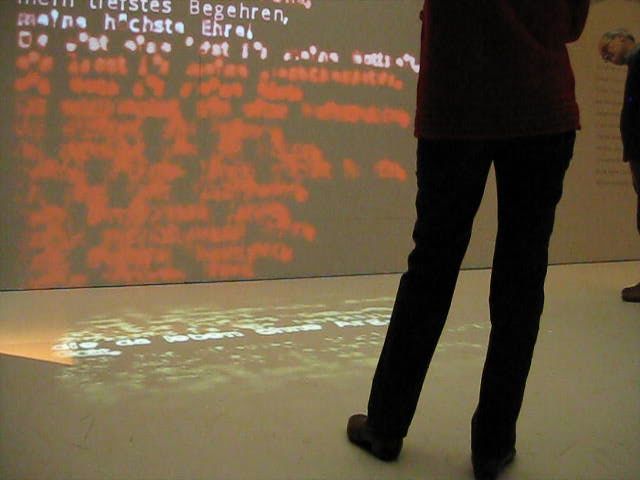
As an expert in Christian mysticism, I developed the following multimedia stations:
- Mechthild of Magdeburg: scenographic concept for the 'Shower of Grace' The Flowing Light of the Divine (text and audio recording);
- Meister Eckhart (excerpts from the radio play);
- Henry Suso (scenography for the radio play). I also contributed to the catalogue and led guided tours.
What is Mysticism?
Sternstunde Religion
Among the many radio and television features covering the exhibition was a discussion on mysticism. On the Swiss television programme 'Sternstunde Religion', host Judith Hardegger spoke with her guests Alois M. Haas and Hildegard E. Keller.
The Ocean
Cinematic installation
Audio Theatre
The new 'Trilogy of the Timeless' generated considerable interest in Bloomington. Diane Fruchtman presented the trilogy as a whole, while Julia Karin Lawson reviewed 'The Ocean in a Thimble'; both articles were published in the Medieval Studies Institute's newsletter at Indiana University.
The idea of creating an audiovisual space at the Indiana University cinema resulted in the cinematic installation 'The Ocean in a Thimble'. We focused on 90 minutes of the audio play. Russell Sheaffar and I edited images, some of which were animated, onto this soundtrack. The visuals were diverse, ranging from medieval manuscripts to 20th-century black-and-white photographs; this combination created a unique atmosphere of audiovisual storytelling and offered a new aesthetic experience. Students from the departments of German Studies and Religious Studies took part. Screenings in Europe (Germany, Switzerland) followed.
Live Performance
Four years after the premiere of the cinematic installation 'The Ocean in a Thimble', a special performance took place once again at the Indiana University Cinema. It was late February 2016. The exhibition 'The Performative Book', which Rosemarie McGerr and I had curated, was on display at the Lilly Library. 'The Ocean in a Thimble' was announced as part of the programming, this time with English subtitles by Julia Karin Lawson and a live soundscape by Tony Brewer and a team from the Jacobs School of Music's Spound Engineering department. It was a fantastic experience.
Booklet IU Cinema, Spring 2016
Booklet IU Cinema, Spring 2016
Tony performed live foley in the orchestra pit. The soundscape he created was mixed with the film's soundtrack. The sound engineers set up the microphones and did the mixing. Tony worked from the script while the film was projected onto a small screen in the pit.
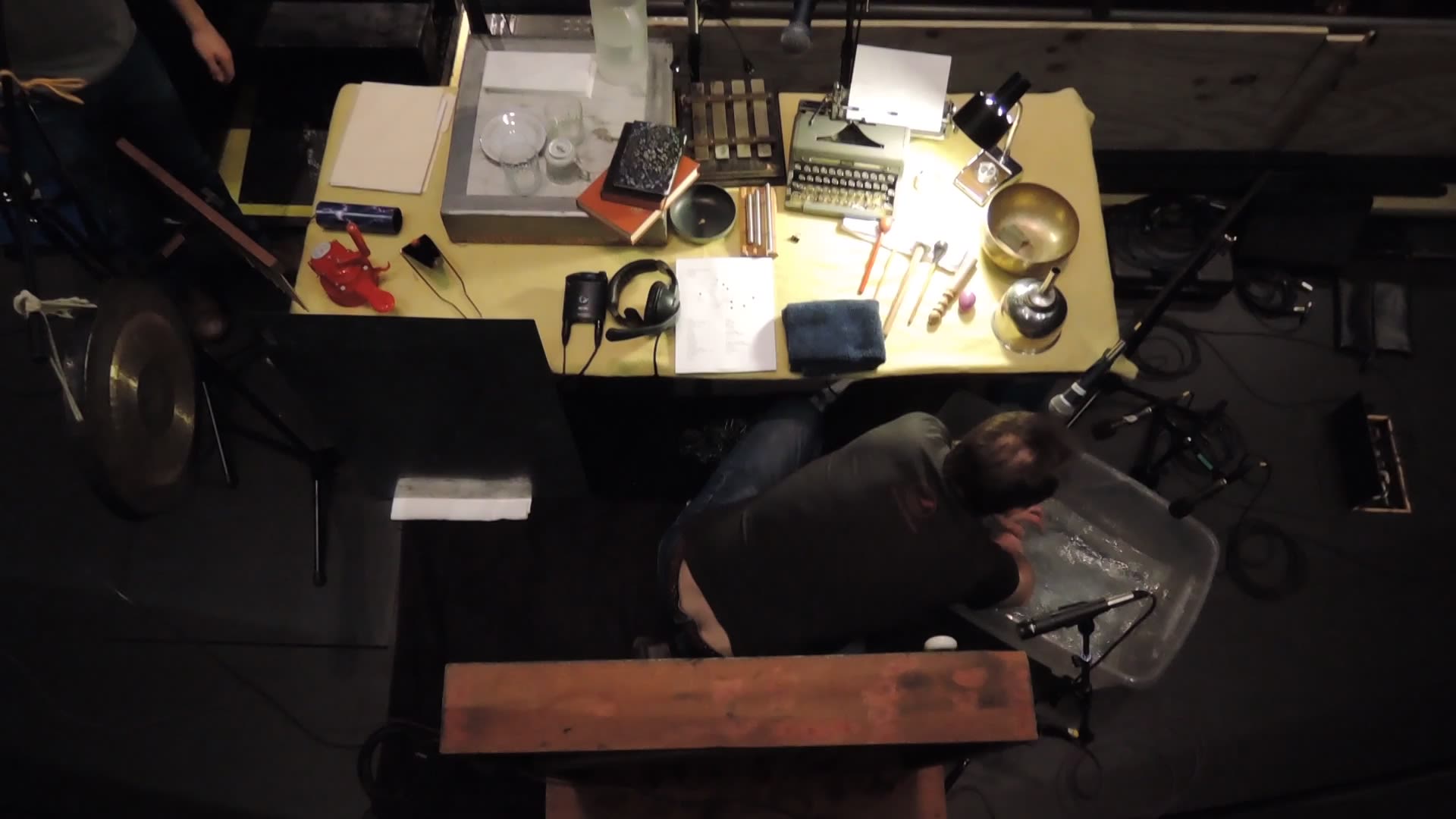
During the performance, the sound engineers ensured that Tony’s foley work blended well with the film’s soundtrack. The experience was akin to a concert accompanying a silent film, or to Double Exposure — the project at Indiana University that brought together students of composition, music production, and film production.
China
While 'The Ocean in a Thimble' travelled to the USA, the camel made it all the way to China, where it was translated into Chinese.
In 2014, the Swiss Arts Council Pro Helvetia invited us to visit several Chinese cities. We were a group of literary scholars and authors. A four-day symposium was held in Zhangzhou in cooperation with Zhejiang University, which brought together both Germanists and translators from China and Switzerland and Swiss writers. I was invited as an author and a Germanist, delivering a presentation at the International Symposium on the Translation, Reception and Study of Contemporary Swiss Literature.
Official portrait, Zhangzhuo
Official portrait, Zhangzhuo
Peter Weber and I then went on a book tour to Beijing. He presented his book 'The Melodyless Years', always accompanied by his jaw harp, while I presented 'The Camel and the Eye of the Needle'. Our tour led to three universities, where there were lively discussions.
Long Night of German Literature. Goethe Institute Peking
Long Night of German Literature. Goethe Institute Peking
During the Long Night of German Literature event at the Goethe Institute in Beijing, the three of us took to the stage: Doris Dörrie, Peter Weber, and me. We read the original text while the Chinese translation was projected onto the wall for the audience. Zhuangzi had the audience in stitches. He is no stranger in modern China.
Praise for the Trilogy
A brilliant idea. Absolutely lovely.
A magic carpet that transports us into an intimate place of active listening.
The 'Trilogy of the Timeless' is an original and lovingly crafted combination of an audiobook, a reader and a picture book. While its primary focus is the mysticism of the German Middle Ages, it also spans vast arcs of space and time, reaching back to the fourth century BC and the Chinese philosopher Zhuangzi and forward to the twentieth century and the Dutch-Jewish woman Etty Hillesum, who perished in Auschwitz. Hildegard E. Keller combines scholarly knowledge with intuition and dramatic talent.
The original Middle High German quotations spoken by Keller himself demonstrate the most beautiful musicality of language, flowing from a 'living heart'.
This is unusually refreshing.
We are struck by the wonderful weaving of the four woman and the inner and outer journey between them and in us. Thank you very much for “The Ocean in a Thimble”. We read the sub-titles in English so it was a different kind of experience with the written word woven in. It looks like you are doing much interesting work in the world. Again gratitude for your work and sharing it with us!
The concept is just as impressive as its execution.
I thought the film was extraordinary! Congratulations.
This is an ambitious work, unique in its kind. It seeks to bring medieval mysticism to life by disregarding the boundaries usually taken for granted in traditional publications, such as those between text and image, reading and listening, the Middle Ages and the modern era, and East and West.
This is a Gesamtkunstwerk.
The distant is so close. Voices from medieval convents provide an amazing sense of immediacy.
Made with love and care
Hildegard Keller succeeds in making the fictional conversation feel warm and light-hearted at times, while always being underpinned by the love and deep understanding between these two strong, yet very different, women.
We medievalists traverse disparate times, geographical regions, cultures, languages, and genres, and also the divide between scholarship and popular perception so that wider audiences can access the true richness of the Middle Ages. Rarely do we have the opportunity to cross all these boundaries at once. This is precisely the project that Hildegard Keller, Professor of Germanic Studies, has engaged in.
This audiovisual masterpiece captivates modern audiences.
A treat for the ears!
This multimedia treasure trove is sure to spark your interest, as it brings a 700-year-old world to life.
An ambitious project of an audiovisual experience.
A gripping account of a life and its trials, often verging on the criminal.
If you're looking for spiritual food for your soul, the 'Trilogy of the Timeless' is a great find. The way Hildegard, Mechthild, Hadewijch and Etty talk to each other is deeply fulfilling.
What I really admire about Hildegard Keller's work is the way she gives everyone else a lot of space, without putting herself in the spotlight. She's interested in the life stories of historical figures because she wants to understand other people. She provides an unobstructed view onto her figures. I take a bow and acknowledge this literary technique and attitude.
Last but not least
The ‘Trilogy of the Timeless’ owes its existence to many people. The narrators can be seen in the photo gallery, while the co-authors are featured in the books. I'd like to express my gratitude to two men in particular.
Alex Dürr took on the enormous and incredibly meticulous task of recording, editing and mixing over 220 minutes of audio drama. He received a thank-you letter from the camel.
I would like to thank Linus Hunkeler for his fantastic dedication and professional expertise in producing the Trilogy of the Timeless. Our smallest multi-volume set in terms of format is also the most innovative in terms of bookish innovations.
What else?
The English translation of 'The Camel and the Eye of the Needle' was produced in Bloomington; we recorded it at Russian Recording. The audio play is scheduled to be completed in 2027.
 Built with Shorthand